


Author: Harris Zhang
Navigating the world of virtualization licensing can often feel like trying to solve a complex puzzle, with hidden costs and confusing rules. For years, VMware has been a go-to choice, much like a popular burger joint that everyone flocks to. But what happens when that favorite spot suddenly changes its menu, forcing you into expensive, bundled meals you don’t need?
Following Broadcom acquisition, many VMware users are facing this exact scenario: a landscape of complex licensing, forced product bundles, and soaring subscription costs that bring more headaches than benefits. If you’re tired of the licensing games and unexpected audits, it’s time to explore a more transparent and flexible alternative.
The New Reality of VMware’s Licensing
What exactly has changed for VMware users? The shift has been significant. The old “a la carte” model, where you could pick and choose the specific products you needed, is gone. Today, customers are pushed toward bundled solutions, which can lead to paying for features and capacity you simply don’t use.
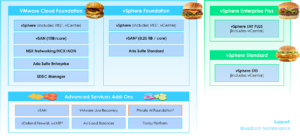
Let’s break down the key challenges:
- Forced Bundles: Essential security features like the vDefend Firewall are no longer available as standalone products. Instead, they are exclusively offered as add-ons to the comprehensive VMware Cloud Foundation (VCF) package. This means that to get one specific tool, you might be required to purchase an entire suite.
- Soaring Subscription Costs: The move to a subscription model has come with steep price increases. A three-year subscription is now 50% more expensive, and a five-year term has doubled in price compared to the previous perpetual license model.
- Mandatory Over-Licensing: As of April 2025, the minimum core purchase requirement per CPU is set to jump from 16 to 72 cores. This policy forces many customers to license far more capacity than they actually need, leading to significant unnecessary spending.
- Expensive Storage Scaling: Expanding your storage with vSAN can also bring unexpected costs. If you need more storage than the initial free entitlement, you are required to re-license the entire raw capacity, making scaling a costly endeavor.
This new model has left many IT leaders feeling trapped, facing a future of unpredictable costs and diminishing flexibility.
The Sangfor Recipe: Simplicity, Flexibility, and Transparency
In contrast to this complexity, Sangfor offers a refreshing approach to virtualization pricing, built on clarity and choice. Think of it as a gourmet burger bar where you can build your own meal with exactly the toppings you want, without being forced to buy a combo.
Here’s how Sangfor’s model stands out:
- A La Carte Freedom: Sangfor allows you to choose only the modules you need. Whether you require server virtualization (aSV), storage optimization (aSAN), or networking virtualization (aNET), you can select individual components to fit your specific requirements without paying for bundled extras.
- Lean and Efficient: The platform is designed to be lightweight and efficient, free from unnecessary features. This ensures you get enterprise-grade performance without the luxury price tag.
- All-Inclusive Bundles: While Sangfor offers bundled solutions like Sangfor Unified Cloud, these are designed as unified, comprehensive stacks that provide value without forcing unnecessary components on the user. You get a complete solution with security, container, database management, and disaster recovery built-in, but the choice is always yours.
A Clear Menu: VMware vs. Sangfor
Let’s put the two models side-by-side. Where VMware now offers rigid, bundled packages like vSphere Foundation and VMware Cloud Foundation, Sangfor provides a flexible range of solutions that can be tailored to your needs.
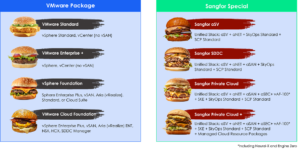
This flexible structure ensures that you are only paying for the functionality you need, giving you greater control over your budget and infrastructure.
A Smooth and Progressive Transition
Worried about a complex migration? Sangfor is designed to co-exist with your current setup, allowing for a gradual and seamless transition. For instance, if you rely on Veeam or Veritas for backup in your VMware environment, you don’t have to abandon it. Sangfor HCI can integrate with Veeam or Veritas, allowing you to protect your existing investment while expanding your infrastructure with a more cost-effective solution.
You can also start by using Sangfor hDR or native aHM for disaster recovery for your VMware workloads or to manage both platforms from a unified interface before deciding on a full migration. This phased approach minimizes disruption and allows you to move at a pace that suits your business.

Just because one burger joint is famous doesn’t mean it’s the only option. The recent changes in VMware’s pricing and licensing have created an opportunity to seek out more agile, transparent, and cost-effective virtualization solutions.
With its “a la carte” model, lean architecture, and clear pricing, Sangfor offers a compelling alternative for organizations feeling the pressure of VMware’s rigid bundles and rising costs. Recognized by Gartner® as a Sample Vendor for VMware Alternative in Hyperconverged Infrastructure, Sangfor is a globally trusted choice for innovation and reliability.
If you’re ready to break free from licensing headaches and embrace a future of IT freedom and flexibility, it’s time to explore a new recipe for virtualization.
Click here to see the source website: A New Recipe for Virtualization: Crafted for Simplicity and Flexibility

 Bahasa Indonesia