


Author : Keith Lee
The VMware–Broadcom acquisition has forced many IT leaders to reevaluate their virtualization strategies in 2025. Rising licensing costs, uncertain support models, and increasing vendor lock-in have left enterprises searching for a sustainable alternative. Recognized by Gartner as a Sample Vendor for VMware Alternative, Sangfor has emerged as a reliable solution that delivers simplicity, cost-efficiency, and enterprise-grade performance.
This blog provides a step-by-step VMware exit plan, designed for IT teams who need to migrate smoothly, minimize downtime, and ensure long-term business continuity.
Market Landscape & Industry Trends
- Rising Licensing Costs – New pricing structures have significantly increased the total cost of ownership, straining IT budgets.
- Support Uncertainty – Customers are reporting slower response times and reduced personalized service under the new VMware structure, leaving IT teams concerned about long-term stability.
- Complex Licensing Models – Instead of simplifying operations, VMware’s fragmented modules and layered costs have created administrative overhead and confusion.
Common Challenges Faced by Enterprises
When planning a migration from VMware, IT teams frequently highlight the following considerations:
- Licensing Complexity – Layered VMware modules increase operational overhead.
- Migration Risks – Concerns over downtime and data integrity during transition.
- Integration Gaps – Compatibility with existing storage, backup, and networking solutions.
- Support Availability – Post-acquisition VMware support remains uncertain.
Analyst insights from Gartner and IDC highlight a clear trend: enterprises are prioritizing predictable costs, simplified management, and responsive support ecosystems. This transition has fast-tracked the adoption of alternatives like Sangfor HCI—a software-defined, all-in-one platform with clear pricing and robust local support—empowering IT teams to avoid disruption and stay in control.
Migration Phases & Best Practices
Enterprises migrating from VMware to other virtualization platforms typically follow a structured, low-risk approach supported by automation tools. The process begins with assessment and planning using discovery tools to map workloads and dependencies, followed by a pilot migration of non-critical systems to validate compatibility. Workload conversion tools then repackage VMs for the new hypervisor, enabling a phased cutover strategy that minimizes downtime and maintains fallback options. Finally, performance validation and optimization ensure workloads run efficiently before full-scale deployment.
This methodical approach lays a solid foundation for a smooth transition to platforms like Sangfor HCI, which addresses migration challenges through its streamlined virtualization structure and HCI architecture, built-in backup integration, and 24/7 local support—ensuring business continuity and operational confidence throughout the process.
Phase 1: Assessment & Planning
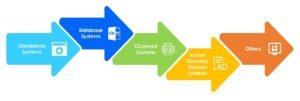
- Audit existing VMware workloads, licenses, and dependencies.
- Identify critical applications and downtime tolerances.
- Use Sangfor’s assessment tools to create a migration roadmap.
Phase 2: Pilot Migration
- Select non-critical workloads for initial testing.
- Validate application performance, integration, and backup workflows.
- Equip IT teams with hands-on training on the Sangfor HCI console.

Phase 3: Full Migration
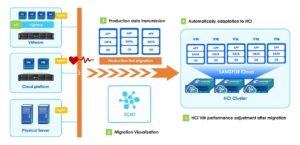
- Leverage Sangfor migration utilities for VM conversion.
- Apply phased cutover to minimize downtime.
- Enable real-time replication to ensure data consistency.
Phase 4: Optimize the Migration
- Provided with Sangfor tools and database tools.
- Leverage built-in database migration tools for tuning.
- Apply SCP with centralized management.
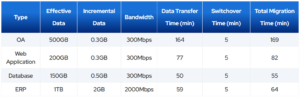
SCMT Migration Time and Interruption Duration Estimation
Tools & Support Options
- Sangfor Cloud Migration Tools (SCMT): Streamlines virtual machine conversion for a smoother transition.
- Professional Services: On-site experts provide hands-on support for complex migration scenarios.
- 24/7 Global Support Centers: regional teams deliver responsive, localized assistance around the clock.
- Training Programs: Interactive labs and practical sessions to upskill IT staff on Sangfor HCI.
Sangfor HCI delivers expert-driven innovation with native VM conversion tools for VMware environments, built-in replication and disaster recovery, and full-stack integration across compute, storage, networking, and security. Certified to work seamlessly with mainstream x86 servers and backup vendors, it minimizes migration risks while future-proofing your IT infrastructure.
Key Takeaways & What to Do Next
Migrating from VMware doesn’t have to be disruptive. With the right tools, a phased approach, and expert guidance, IT teams can transition to Sangfor HCI smoothly and with confidence.
Sangfor HCI is backed by global recognition, including being named a Representative Vendor in the 2025 Gartner® Market Guide for Full-Stack Hyperconverged Infrastructure Software and ranked as the 5th largest HCIS vendor by revenue worldwide for 2024 in Gartner® Market Share report . These recognitions reflect Sangfor’s commitment to innovation, reliability, and customer satisfaction, making it a trusted choice for future-ready IT infrastructure.
Click here to see the source website: VMware Migration Made Easy: A Strategic Exit Plan

 Bahasa Indonesia